


Disclaimer: All ‘rude’ and nonchalant acts, phrase, vulgar & sass (and advice) are for public entertainment only and not to sway you from your personal decisions.
When I first started writing on Substack, I had no idea what I was doing. I had nothing in mind to begin my writing journey with. No drafts, no guides, no nothing, just me…writing to a void. I basically was a dummy just scrolling through an app I had no idea what it was about or even how I got to know about it. I got confused, didn’t open the app for about a couple weeks. I came back later on, after days of trying to understand the shit I was reading on Google on ‘How to Write on Substack,’ which was of no help at all.
One thing those articles fail to capture (that I’d felt it wasn’t written in) is the confusion. That self-monologuing confusion. They write those “guides” like they’re talking to people who have at least 5% of the knowledge and try to get them to a 10%. (But I don’t know shit, and you don’t know shit either, so what then?) That’s why it feels a bit too performative and clickbait-y when they go on to offering courses on Gumroad and all that crap.
You’re a newbie on substack and find it difficult to navigate because it looks like everyone’s got this perfect newsletter and are gatekeeping knowledge on how to use those cool features you see them use and don’t always talk about. Like, “wait, how did she even get that?” “Wait, when did substack even have this?” And instead of reading a newsletter explaining that, all you see is “substack connect me with writers who writes…” frustrating, isn’t it? Makes you just wanna…hit ‘em in the throat. But that’s where I come in—the guy who actually does gives a f*ck and would want to help you figure out how shit works.
If you think Substack is unfair, try writing on Medium for a year with no engagement.
How to Be a “Pro” on Substack
#1. What the F*ck is That Publication?
//Everything you need to know about building your publication//
Before I start, please tell me you have access to your substack’s dashboard, otherwise this would be crap to you.
How to get it?
Check your email for the link assigned from when you signed in on substack, or on the substack webpage, click under your profile for ‘dashboard’, and that’s it. And no, long form notes isn’t how we publish contents.
It kills me to see people misuse their publication, because if you know just how important it is for it to be a source of income for others, maybe you’ll treat it a little differently (some of us can’t). And maybe if you feel stuck, or lagging, then I’d advise you step out of that crappy niche you’re in.
Name
Description
Category (Niche)
Enabling Payment?
About Page
Welcome image
Welcome emails
Sections
Building a publication isn’t always that simple. You gotta come up with the name, the topics you’d want to talk about under that publication, and worse—picking a niche.
Very few persons know this: when creating a publication (i.e.), where your main hub is or topics are gonna be featured under, at some point if you’re looking to expand that, you can create:
Sections (mini pubs) ‘underneath’ it, instead of having up to five f*cking publications. Unless they’re for a different category, don’t.
Categories are where you pick that niche everyone keeps telling you about—education, art, music, literature, philosophy, etc.
Descriptions tells people about your publication (this is very different from bio), writing category, and well…you & what to expect in the long run. We need to understand you first before we join in on the madness.
About page is a longer form of that one sentenced description for your publication. Maybe 5-10, a whole paragraph (hey, people do that) about you, what you write about, your purpose and what you want other people to learn from you and why you want us to.
Enabling payments? 404: Page Not Found.
Welcome emails. They’re emails that are automatically sent out when you publish a piece.
Welcome images. They’re what invites people to your publication. It displays the welcome image you choose, publication description, how long you’ve had it and the publications you recommend.
#2. Your Newsletter isn’t a Frickin’ Spotify Playlist.
If you want people to look at your post while scrolling and go “wow” enough to subscribe from just the thumbnail and title, do this instead: edit that title into something click-worthy.
Sometimes what really reels readers in is the title. Don’t just write and title your read with something as simple as “Grief,” “Love,” etc., look around, do the bestsellers and the writers you like, title their works that way? No.
It's always: “How to do this,” “How to do that,” “This is why…” or on posts that take different routes that warrants it’s unique title. A title can come from a line in your read—something powerful to draw people in to read.
Titles have to be elaborate—they have to contain the emotion of your read like a sentence—love, hurt, humor, all that. So, write your titles like sentences not Spotify playlist’s. My title is exactly what I’m trying to explain. What did you feel when you saw it? Humor? Maybe. Now imagine if I’d titled it “New writers,” or “Substack” (yeah.)
#3. Let’s Add Some Color (Life) to That Boring Publication.
So, you’ve wondered “how do they make their publication so aesthetic?” “how can I do that too?” it’s simple, and the answer to that is in your website editor. In your dashboard (which I’m sure you have) you’d see a ‘website theme editor,’ click that. It’ll take you to where you’ll see your really scattered and boring publication.
Now, here’s where the tricky part is; it’s you who’d determine how you want it. And just know, whatever changes you make, you can see them to verify before saving. You’ll first see ‘branding,’ which is where you add in your (and by now, you must’ve had) publication image, wordmark (that ‘written by Kingsley’ on top, colors (accent & web background), typography (whatever font you want—headers, body) and link style (colored or underline).
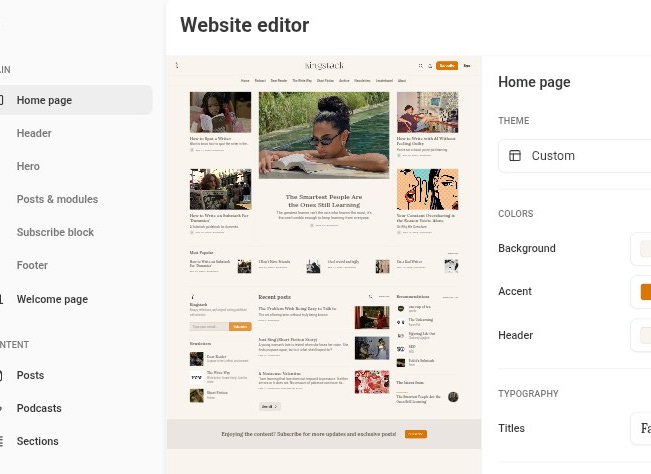
The next is the ‘homepage.’ You’ll choose a style you want (magazine, newspaper, highlight, feature, or media highlight). Determine if you want your top posts to be displayed or not. Advanced layout is like if you want to over-beautify your website (like me, who does) so it looks aesthetic enough and pleasing.
You’re probably not gonna hear this from anyone but the “trick” to writing on Substack is not by ‘consuming more’ (I don’t even read that much tbh), or doing one or two growth hacks, but by being you (yes, you psychopath). That’s it. There are growth hacks (e.g. recommendations, social media presence, tags, etc.) but the one truly does stick is the authenticity.
“The key to growth on Substack isn’t always publishing consistently, and some writers ‘know that’ — Ana Calin

#4. Fix that Dumb Bio.
A bio is an ‘introduction’. Just something to make the other person go “ohh,” “ha-ha,” “wow, that’s smart,” depending on what you want them to know about you—something that truly stands out. It should be new, strong, memorable, witty & clever. You don’t want a weird bio that makes people cringe when they see it.
Some people have really good bio’s (the ones that make you pause and admire them), and some people have ones that needs more work, but all are bio’s nonetheless. Because yours isn’t as flashy doesn’t make it a less of what it is. The professional, business writers have bio’s that sets them apart—the “I help you…”’s.
#5. Write Some Damn Words.
Now that your publication is up and running, all you need to do now is to write some damn words. Some writers usually get worn out and post “I’m taking a break from Substack for now…”, fix that by knowing how frequent you want to write—that’s it.
What to do?
Know when you want your work published, or when to write (so you don’t murder yourself one day). Do you…want to write:
Daily? (Bad option)
Weekly? (once a week. So, great)
Bi-weekly? (twice a week. Not so great)
Monthly? (shut. up. Really?)
Bi-monthly? (eh…liked monthly better)
#6. Choose the Right Tags.
Choosing a tag on Substack is just like choosing tags on your Instagram, tiktok or twitter posts but with slight difference, since it’s on substack. Remember when I said you’d have to choose a category? That’s what you’re gonna be tagging to get views.
Here’s the thing:
This is an educative post (right?), and both my niches are education + culture. I will tag it as ‘education’ for people in that niche to see it. Now, the relative tags would be: ‘Substack,’ ‘Substack writers,’ ‘New Writers,’ ‘How to Write,’ ‘How to Write on Substack For Dummies,’ (yes, even the title itself) and basically, anything with a ‘how to’ post is an educational content. Understand it now? If you still don’t, ask chatgpt.
There’s this ‘backdoor’ tagging Ana Calin spoke about. It’s like tagging two niches to save time, basically. So, instead of tagging your newsletter: ‘technology,’ ‘business’ separately, you can just: ‘business’ + ‘technology,’ ‘health + wellness’ it and it gets delivered to both those niches. Smart, isn’t it?
One thing about this feature? You can write on anything outside your niche, and it will get read. Say you write about art or music, who says you can’t write a philosophical essay? Don't let your niche cage you.
#7. Your Title is a Test Monkey.
There’s a new feature on Substack—the title test runs, or A/B title testing. Maybe you have five different title ideas for a specific post, you can see when the current title is changed into the ones you added. What this does for your post is: it gives your post a chance to play with all the title ideas and see the ones that readers get drawn to the most and going with it. It’s a great way of drawing in readers.
#8. Hook ‘em Right Outta the Gate.
What’s all this recent bravado about hooking your readers with the perfect title, subtitle (which are important btw) about? Can’t I just creatively express myself without having to boost or use right optimized titles (to get read? yes)?
“We’re humans not some AI bots that needs indexing.”
(Read below)
#9. Schedule, Publish, Repeat.
Now you’ve written the damn thing, what’s left on the list is to publish it, or if you’re a bit picky and indecisive (like me), you can schedule the date on when you’d want it out.
(Huh. Finally, something so short and self-explanatory).
#10. Spread that Newsletter Like it’s Gospel.
I take sharing my works on social media (twitter, tiktok, instagram) to the core (and of course), with a reasonable amount of unhinged writer. For me, it’s like everyone (including you) must read and cannot escape my newsletters. I didn’t spend 5 hours writing shit that no one would read, even though based on real life events (no one does), I think my words have to account for something and shall not be left to rot in my pub. So, if you’re like me (a writer, who isn’t yet read) you’d do same and annoy other writers with your presence.
Psstt. Hey,
Follow these Writers to Get Better
The writer’s I’d be referring to you, each have published works that I sometimes re-read, because they’ve helped me a lot—in terms of my writing style, tone (okay, not really), articulation, and overall, understanding how shit here works. They’re all female. :3
Karen Cherry – She writes ‘PubStack Success’
Jennie O'Connor – She writes ‘Down the Rabbit Hole
Ana Calin – She writes ‘How we Grow’
Claudia Faith – She writes ‘Wander Wealth’
Linda Caroll – She writes ‘Hello Writer!’

The point where I might need hand holding while I walk through this
My eyes are sore now
Waooohhh that was really informative. Now I think I need to step up my game with all these tips and tricks 😅